
 Delicious and effective at combating pathogens! The triangle in the upper left is a splinter that's broken the skin (yellow horizontal line). The green dots around the splinter are incoming bacteria. Look closely and you'll also find cytotoxic T cells, neutrophils, antibodies, macrophages, and more!
Monday, November 18, 2013
Immune System Cake!
Delicious and effective at combating pathogens! The triangle in the upper left is a splinter that's broken the skin (yellow horizontal line). The green dots around the splinter are incoming bacteria. Look closely and you'll also find cytotoxic T cells, neutrophils, antibodies, macrophages, and more!

Saturday, October 19, 2013
Introducing Elements, our new science research journal

How to make airplane wings or solar panels more efficient?
Sources of air pollution at Catlin?
How neurons in the nose are connected to each other?
How your socks may be contributing to the degradation of local water ecosystems?
Find out more about these and other burning questions in Elements, Catlin's new student science research journal.
Thank you to all the contributors!
Tuesday, September 10, 2013
World Water Week in Stockholm
 | |
|
 | |
|
Thursday, May 2, 2013
Rocket Launch
The US Science Research class recently took advantage of our lovely spring weather (and lack of wind) to launch the rockets they built. This is a model of the V2 rocket, the grandparent of them all (and can you spot the little itty bitty rocket in the photo?):


Monday, February 4, 2013
Science Bowl 2013
At Saturday's BPA Regional Science Bowl competition, 66 from schools all over Oregon and Washington battled for the top place. We're proud of all the students who participated on Catlin's three teams this year; it was really neat to have so many students participate!
Special congratulations to this gang who finished in 2nd place overall, losing only their final bout:

Special congratulations to this gang who finished in 2nd place overall, losing only their final bout:

photo credit: BPA
Wednesday, October 10, 2012
Science & Engineering Indicators 2012
These figures come from the National Science Board, which has published a report that contains "a broad base of quantitative information on the U.S. and international science and engineering enterprise."
The full report is on their website and is quite detailed.
This excerpted table contains data showing how students in various countries responded to the same questions, which makes for more direct comparisons:
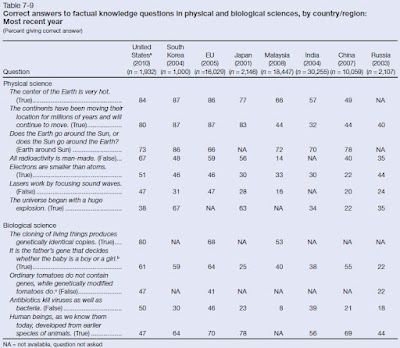 The tomato genes question is my favorite.
And this table compares scientist vs. public opinions on several STEM topics. It's quite interesting to see by how much the numbers differ in the two columns:

The full report is on their website and is quite detailed.
This excerpted table contains data showing how students in various countries responded to the same questions, which makes for more direct comparisons:

And this table compares scientist vs. public opinions on several STEM topics. It's quite interesting to see by how much the numbers differ in the two columns:

Tuesday, June 5, 2012
Venus Transit

By some miracle, we had a brilliant sunny afternoon today for observing the transit of Venus across the sun at Catlin. The larger bright circle is an image of the sun, projected through binoculars onto a paper. The tiny dot on the lower left is Venus, making her way from the lower left to the upper right of the bright circle. There are lots of higher resolution images online, but we had lots of fun watching this in person. It'll take about 6 hours for the transit to finish, but once it's over, you'll have to wait until December 2117 to see the next one!


Subscribe to:
Posts (Atom)