
 Delicious and effective at combating pathogens! The triangle in the upper left is a splinter that's broken the skin (yellow horizontal line). The green dots around the splinter are incoming bacteria. Look closely and you'll also find cytotoxic T cells, neutrophils, antibodies, macrophages, and more!
Monday, November 18, 2013
Immune System Cake!
Delicious and effective at combating pathogens! The triangle in the upper left is a splinter that's broken the skin (yellow horizontal line). The green dots around the splinter are incoming bacteria. Look closely and you'll also find cytotoxic T cells, neutrophils, antibodies, macrophages, and more!

Saturday, October 19, 2013
Introducing Elements, our new science research journal

How to make airplane wings or solar panels more efficient?
Sources of air pollution at Catlin?
How neurons in the nose are connected to each other?
How your socks may be contributing to the degradation of local water ecosystems?
Find out more about these and other burning questions in Elements, Catlin's new student science research journal.
Thank you to all the contributors!
Tuesday, September 10, 2013
World Water Week in Stockholm
 | |
|
 | |
|
Thursday, May 2, 2013
Rocket Launch
The US Science Research class recently took advantage of our lovely spring weather (and lack of wind) to launch the rockets they built. This is a model of the V2 rocket, the grandparent of them all (and can you spot the little itty bitty rocket in the photo?):


Monday, February 4, 2013
Science Bowl 2013
At Saturday's BPA Regional Science Bowl competition, 66 from schools all over Oregon and Washington battled for the top place. We're proud of all the students who participated on Catlin's three teams this year; it was really neat to have so many students participate!
Special congratulations to this gang who finished in 2nd place overall, losing only their final bout:

Special congratulations to this gang who finished in 2nd place overall, losing only their final bout:

photo credit: BPA
Wednesday, October 10, 2012
Science & Engineering Indicators 2012
These figures come from the National Science Board, which has published a report that contains "a broad base of quantitative information on the U.S. and international science and engineering enterprise."
The full report is on their website and is quite detailed.
This excerpted table contains data showing how students in various countries responded to the same questions, which makes for more direct comparisons:
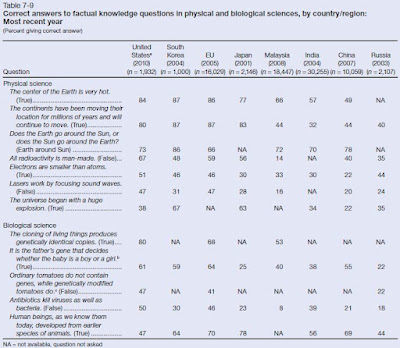 The tomato genes question is my favorite.
And this table compares scientist vs. public opinions on several STEM topics. It's quite interesting to see by how much the numbers differ in the two columns:

The full report is on their website and is quite detailed.
This excerpted table contains data showing how students in various countries responded to the same questions, which makes for more direct comparisons:

And this table compares scientist vs. public opinions on several STEM topics. It's quite interesting to see by how much the numbers differ in the two columns:

Tuesday, June 5, 2012
Venus Transit
By some miracle, we had a brilliant sunny afternoon today for observing the transit of Venus across the sun at Catlin. The larger bright circle is an image of the sun, projected through binoculars onto a paper. The tiny dot on the lower left is Venus, making her way from the lower left to the upper right of the bright circle. There are lots of higher resolution images online, but we had lots of fun watching this in person. It'll take about 6 hours for the transit to finish, but once it's over, you'll have to wait until December 2117 to see the next one!


Monday, February 20, 2012
Tiny Creature Roundup
Anyone else noticed the abundance of small organisms in the news lately? Let's take a tour, starting with the leaf chameleons from Madagascar, which are described as an "extreme case of island dwarfism" at less than 30 mm, full size. A recent PLoS ONE article describes them. Here's a juvenile:

Next, here's a recently discovered terrestrial frog from New Guinea, described as "the smallest known vertebrate species, attaining an average body size of only 7.7 mm" in a different PLoS ONE article. These itty bitty frogs are described as likely prey for scorpions and other large invertebrates.

Speaking of invertebrates, the fairy wasp is one fifth of a millimeter long. Note the scale bar in the photo! Even more interesting is that the adult wasp's nervous system has just a few thousand neurons, most of which do not have nuclei. The juvenile cells seem to accomplish enough protein synthesis before losing their nuclei to last through the wasp's 5 day adult lifespan.

This guy seems giant in comparison, and he'll certainly grow more, but Lil' Drac is an adorable short-tailed fruit bat, abandoned by his mom, but cared for by humans. These videos have a pretty high awww factor.

Videos:
http://www.youtube.com/watch?feature=player_embedded&v=FkeSSdwbnPg
http://www.youtube.com/watch?feature=player_embedded&v=kldBXAB2Kws
Next, here's a recently discovered terrestrial frog from New Guinea, described as "the smallest known vertebrate species, attaining an average body size of only 7.7 mm" in a different PLoS ONE article. These itty bitty frogs are described as likely prey for scorpions and other large invertebrates.
Speaking of invertebrates, the fairy wasp is one fifth of a millimeter long. Note the scale bar in the photo! Even more interesting is that the adult wasp's nervous system has just a few thousand neurons, most of which do not have nuclei. The juvenile cells seem to accomplish enough protein synthesis before losing their nuclei to last through the wasp's 5 day adult lifespan.
This guy seems giant in comparison, and he'll certainly grow more, but Lil' Drac is an adorable short-tailed fruit bat, abandoned by his mom, but cared for by humans. These videos have a pretty high awww factor.
Videos:
http://www.youtube.com/watch?feature=player_embedded&v=FkeSSdwbnPg
http://www.youtube.com/watch?feature=player_embedded&v=kldBXAB2Kws
Friday, November 11, 2011
A topical post....

Who says that scientists are humorless, dour individuals out of touch with the real world? Thanks to Larry Hurst for this lighthearted end to the week.
Tuesday, November 1, 2011
DNA Infographic--Guest Post


 Oh, wow. This is my first blog guest post. I'm both honored and humbled at being invited to contribute to the Catlin Coverslip. My first thought when Dan invited me to post was what on earth could a social studies teacher contribute to a science blog? Then I began breathing again and remembered how much fun I've been having the past few years sending Dan, Becky, and Veronica science related tidbits I felt were in keeping with the Coverslip's intent. Today, I offer two infographics for thought. I suppose they are related in a way. My daughter, Noa, is currently studying genetics, so I thought this dna related infographic might be of use to her and her sophomore classmates. Now that Earth's population has passed the 7,000,000,000 (numbers are so much more impressive than words) milestone, revisiting Per Square Mile's density infographic also seemed appropriate. I also promise to return to the spirit of the Coverslip with a much shorter post next time.
Thursday, October 20, 2011
Teenage Brain Roundup
All sorts of interesting tidbits in the news lately about the teenage brain:
Paul Monheimer points out that this month's National Geographic features an article on the teenage brain, which is available online here.
Dan Griffiths points out the recent study, "Online social network size is reflected in human brain structure" that yes, shows a positive correlation between number of Facebook friends and gray matter density in certain areas of the brain involved in social perception and associative memory.
Finally, check out the recent report from British researchers on how verbal & non-verbal IQ can fluctuate throughout the teenage years. Here's a summary of their work:
Happy reading!
Friday, September 23, 2011
Ocean Salinity Mapping
 Paul Monheimer shares this BBC article about mapping ocean salinity via satellite with us. The article has details about how the map is created via data gathering probes in the oceans.
It's neat to look at the map and see that the Pacific is apparently less salty than the Atlantic. Any oceanographers out there have an explanation for this?
Here's the full article:
Wednesday, August 24, 2011
Water Fountain Physics
 Paul Monheimer shares this Wired post about a hi-tech water fountain in a Japanese mall that can make complex pictures and words with the falling drops - "Happy" is spelled out in the photo.
The article has some great video of the fountain running, as well as some neat video and graphs to explain how the separation between drops as they fall can be predicted by kinematics equations. Check out the videos!
Sunday, June 5, 2011
Slow Motion Videos: Deformation and Motion
Gelatin Cubes, by Modernist Cuisine
Water Balloon To the Face, from Discovery Networks
Hat tip to Ben Rimes
Water Balloon To the Face, from Discovery Networks
Hat tip to Ben Rimes
Friday, May 27, 2011
Middle School Science Olympiad Success

 Submitted by Larry Hurst, 6th grade science teacher:
Great news from the 2011 National Science Olympiad in Madison, Wisconsin:
Middle Schoolers Eve Maquelin and Andrew Park competed against 118 students in grades 6 through 9 from 47 states to win 1st place in the nation for the Science Olympiad event “Write it, Do it”.
Andrew and Eve’s gold medal performance is stunning when you consider that “Write it, do it” is one of the most challenging of the tournament’s 23 events. For a pair of novice 6th and 7th grade students to beat 59 other schools in teamwork, abstract expression, logic, and concise writing is an impressive achievement and indicative of the strength of our science and language arts programs at Catlin Gabel School.
This was the first medal earned by an Oregon team since Calapooia Middle School got both a gold and a bronze medal in 1997. Prior to that, Whitford Independent School got gold and silver medals in 1993, gold and bronze in 1992, and a gold medal in 1989.
Bravo, Eve and Andrew!
Monday, May 23, 2011
Vignesh makes the final!!!
From Andrew Merrill, our Computer Science teacher:
Google is running a world-wide science fair for the first time this year. Out of over 7500 entries from around the world, they have narrowed it down to 5 Finalists in each of three age ranges (13-14, 15-16, 17-18).
Vighnesh Shiv was just named today one of the 5 Finalists in the 17-18 age category. The finalists will all be flown to Google HQ in July for a science fair with judges that include “Nobel Laureates, tech visionaries and household names.
Check it out at the link below:
http://googlesciencefair.blogspot.com/2011/05/votes-are-in-for-google-science-fair.html
Monday, May 9, 2011
Google Science Fair People's Choice Award
 The Google Science Fair has opened public voting until May 20 for their

People's Choice Award - visit this link to see the incredible projects that have been submitted.
While you're there, check out the project submitted by our very own Vighnesh, class of 2011, "Foundational Algorithms for Music Analysis with Wide Applicability in Signal Processing". You can read all about his project details and watch a summary video on his Google page.
Don't forget to vote for Vighnesh!
Spinning Along Nicely: team TURBINE is recognized for their work
 Did you hear? Catlin's Team TURBINE is the Oregon State Finalist in the Siemens We Can Change the World Challenge - congratulations to Sarah, class of 2011, and Marina and Mark , class of 2013!
Click here to watch the fantastic video, made by Cody, class of 2013.
Here's a past Coverslip post that describes the details of their project.
Friday, April 22, 2011
Cardiovascular System

This is Valerie, class of 2013, and her fantastic cardiopulmonary system diagram. Wow, what a lovely intersection of art and science. This photo really doesn't do it justice, but you can zoom in to fully appreciate the tiny details!
Sunday, April 3, 2011
Radiation Dose Chart

Thanks to Alan, class of 2013, for sharing. You can click on the image to enlarge and read the tiny print.
Subscribe to:
Posts (Atom)